Charging Station Infrastructure and Installation Checklist

Electric Vehicle & Charging Station Industry

Accessibility & User Interface - Critical
Display screens readable and show accurate data.
Signage for charger type/connector/voltage is visible.
Cables/connectors reach vehicles without strain.
QR/RFID authentication available.
Critical - Electrical Setup & Cabling
Power connection capacity matches total charging load demand.
Cables used are rated for current capacity, temperature, and voltage as per IS 694/1554.
All electrical terminations are tightened, insulated, and labeled properly.
All cables are routed through conduits or cable trays with no exposure to mechanical damage.
Cable insulation resistance is tested and documented before commissioning.
Main distribution board (MDB) for charger has proper MCB/MCCB protection.
Earthing provided for each charger foundation and connected to main earth grid.
Metallic conduits and structural components are bonded to earth.
Lightning arrestor installed and tested as per IS/IEC 62305 standards.
Surge protection devices installed at input and output terminals of chargers.
Critical - Metering & Power Quality
Energy meters are installed for each charger and are calibrated.
Voltage/current harmonics within IEEE 519 limits.
Power factor correction devices installed if required.
Phase balancing across charging stations is maintained.
Energy monitoring integrated with SCADA/CMS.
Documentation & Records - Installation Files
Installation checklist and commissioning reports filed and signed.
As-built drawings updated and available on site.
Operation manuals, load calculations, SLD stored digitally.
Maintenance - Structural & Mechanical Setup
Charger mounting structures are rust-free and painted with protective coating.
Bolts, anchor plates, and mounting hardware are securely fastened.
Charging station canopy or shelter is installed and structurally sound.
Cable trenches and junction boxes are covered and labeled properly.
Cooling/ventilation provision available for high-capacity DC chargers.
Safety - Fire & Electrical Protection
Fire extinguishers (Class C/CO₂) available near chargers.
Emergency stop switches installed and accessible.
Electrical panels have danger signages and insulation mats.
Charger area has adequate night illumination (>100 lux).
No flammable material within 5 meters of charging bay.
Super Critical - Site Selection & Civil Compliance
Charging station site has necessary approvals from local and power authorities.
Site layout ensures safe vehicle entry, exit, and parking space for charging.
Site is free from flood-prone or waterlogging risk areas.
Ground surface is level, paved, and strong enough to support charger and vehicle load.
Civil foundation for charger is constructed as per manufacturer’s dimension and load.
Training & Competency - Installer Qualification
Installation team members are certified electricians/technicians.
Safety induction training conducted pre-installation.
Supervisors trained in EVSE standards (IEC 61851/IS 17017).

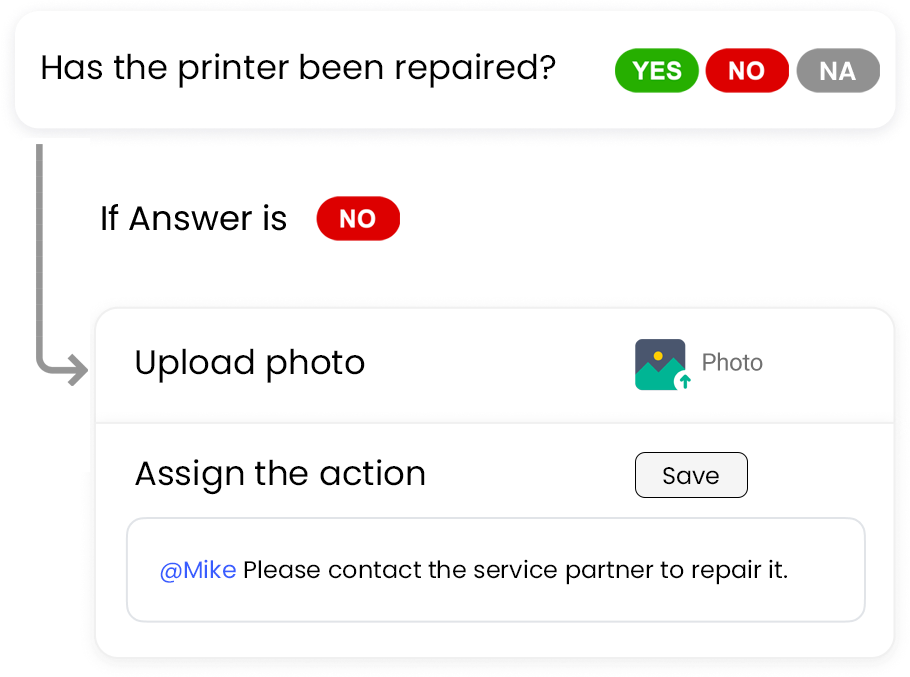
Edit & customize templates as per your needs in simple steps

Pulse allows you to edit the checklists from the library to suit your specific needs. With our smart checklist builder and editor, you can infuse logic in your questions for more clarity and better visibility.

SIGN UP TO EDIT TEMPLATES
Digitize your existing templates in simple steps

Pulse helps you convert your existing inspection templates into digital ones. Simply upload them in PDF, Excel and Word format and leave the rest for our support team. We will get back to you with digital forms.