EV Service Center and Workshop Safety Checklist

Electric Vehicle & Charging Station Industry

Compliance - Hazardous Waste Handling
Hazardous materials (batteries, coolant, solvents) disposed via authorized channels.
MSDS for all workshop chemicals available and staff trained on hazards.
Critical - Diagnostics & Software Safety
Vehicle diagnostic sessions are performed by authorized personnel and logged.
Firmware and software updates applied during service use validated builds only.
Data backup of vehicle logs is taken prior to reprogramming.
Critical - Lockout/Tagout (LOTO)
LOTO procedures are implemented for all electrical and mechanical isolations.
LOTO keys/locks are properly managed and stored to avoid unauthorized removal.
Critical - Personal Protective Equipment (PPE)
Technicians wear appropriate HV PPE (insulated gloves, face shield, arc-rated clothing).
Insulating gloves and sleeves are dielectric-tested and tagged with test date.
No metal jewelry, watches, or conductive items allowed in the service bay.
Documentation - Service Records & Warranty
Complete service report with HV tests, software versions, and technician sign-off is stored per vehicle.
Electrical Safety - Grounding & Bonding
Temporary grounding/earthing straps are used during HV disassembly and tested.
Emergency Response & Communication
Emergency contact list, procedures, and assembly point are displayed and known to staff.
Maintenance - Tools & Calibration
All torque tools, insulation testers, and meters are calibrated and tagged.
Tool control system is used to account for all tools before and after service.
Maintenance - Workshop Equipment
Lifts and hoists are inspected and load-tested periodically.
Compressed air systems have moisture and oil traps and are regularly drained.
Coolant handling systems for battery thermal loops are leak-free and labeled.
Operational - Charging During Service
Charging of customer EVs in workshop follows safe protocol and is monitored.
Charging connectors used for diagnostics are inspected and functional.
Quality - Parts & Traceability
Replacement HV components and batteries are genuine and traceable (part number, batch).
Used/defective parts are tagged and stored separately with job reference.
Quality - Post-Repair Inspection
Post-repair functional check includes high-voltage system health and insulation test.
All safety interlocks (door, charge port, HVAC, etc.) tested after service.
A road/test drive is conducted by trained technician to validate repairs.
Safety - Customer Vehicle Management
Customer vehicles with hybrid or high-voltage systems are identified at intake.
Vehicle keys and immobilizers are handled per security protocol during service.
Safety - Fire & Spill Control
Fire extinguishers (suitable for electrical and lithium fires) are available and serviced.
Spill kits and neutralizing agents are available for electrolyte or coolant leaks.
Safety - Ventilation & Fume Control
Workshop ventilation prevents accumulation of flammable or toxic fumes.
Safety - Workshop Layout & Housekeeping
Work bays are clearly marked with HV hazard signage and restricted access.
Floor is clean, dry, and free of trip hazards, oil, or stray cables.
Super Critical - Battery Removal & Handling
Battery removal and installation follow OEM procedures and use designated lifting equipment.
Battery packs are stored in a ventilated, fire-proof quarantine area when removed.
State of Charge (SOC) before battery handling is within safe limits per OEM (e.g., 20–50%).
Super Critical - High Voltage Service Procedures
High-voltage systems are de-energized and isolated before any service work.
Qualified EV technicians perform high-voltage diagnostics and repairs.
Service area has dedicated HV workbench with insulated flooring and tools.
Training & Competency
Technician competency matrix is up to date with HV and battery certifications.
Regular refresher training for emergency battery incidents is conducted every 6 months.

Edit & customize templates as per your needs in simple steps

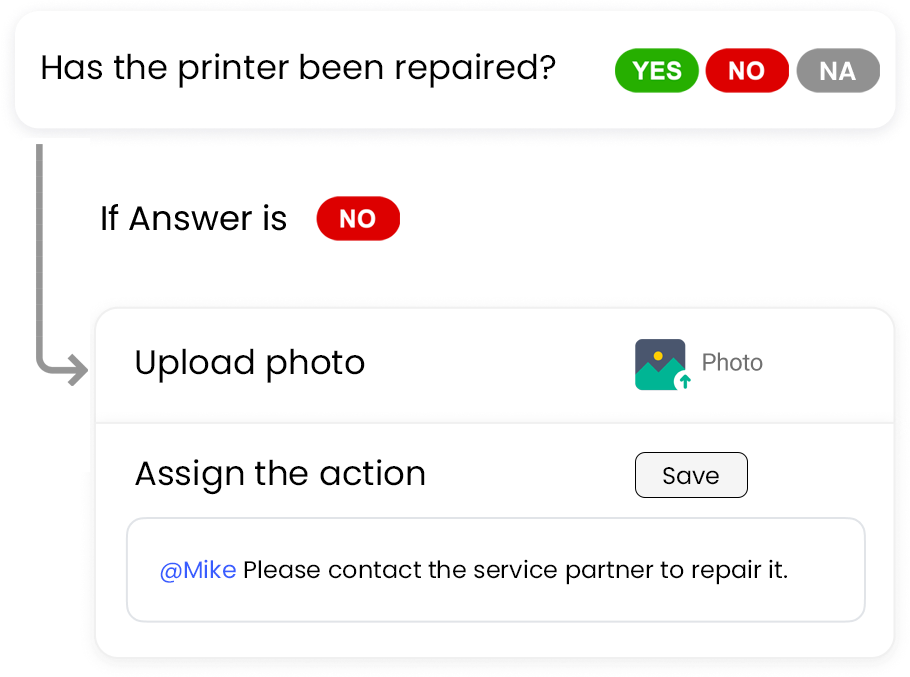
Pulse allows you to edit the checklists from the library to suit your specific needs. With our smart checklist builder and editor, you can infuse logic in your questions for more clarity and better visibility.

SIGN UP TO EDIT TEMPLATES
Digitize your existing templates in simple steps

Pulse helps you convert your existing inspection templates into digital ones. Simply upload them in PDF, Excel and Word format and leave the rest for our support team. We will get back to you with digital forms.