Battery Management and Thermal Safety

Electric Vehicle & Charging Station Industry

Critical - Battery Assembly & Integration
Cells are matched for voltage and internal resistance before assembly.
Busbars, cables, and connectors are free from corrosion and secured properly.
Thermal interface materials (TIM) are applied evenly to ensure uniform heat distribution.
High-voltage connections have insulation sleeves and terminal covers installed.
Battery enclosures meet IP67/IP69 protection rating.
Cell voltage, temperature, and SOC (State of Charge) are recorded after assembly.
All battery fasteners are torqued as per assembly specification.
No physical damage (dent, swelling, puncture) is observed in any cell before welding.
Cell tabs and weld joints are visually and electrically tested.
Critical - BMS (Battery Management System) Functionality
BMS firmware version and calibration ID are verified.
BMS performs cell balancing correctly within defined voltage limits.
Communication between BMS and vehicle control unit (VCU) is stable.
BMS diagnostic and fault logging features are active.
BMS current measurement and SOC estimation accuracy are verified.
Documentation & Records - Testing & Traceability
All charge/discharge test logs are maintained digitally.
Each battery pack has a unique QR/barcode for traceability.
Battery safety data sheets (MSDS) are available and accessible.
Battery test benches are equipped with calibrated measurement instruments.
Fire Control & Emergency Preparedness
Fire suppression system (inergen, aerosol, or dry powder) is installed in battery zones.
Temperature alarms are integrated with plant fire alarm system.
Battery fire blankets or sand buckets are available in assembly and test areas.
Emergency evacuation routes are defined for battery assembly zones.
Fire drills specific to battery incidents conducted every 6 months.
Maintenance - Thermal Management System
Cooling fans or liquid cooling systems are functional and leak-free.
Thermal runaway sensors are installed and tested for responsiveness.
Thermal interface materials are replaced as per maintenance schedule.
Temperature gradient across battery pack remains within design tolerance.
Over-temperature cut-off systems are tested quarterly.
Temperature sensors (NTC/PTC) are calibrated and verified periodically.
Storage & Logistics - Critical
Battery packs are transported in shockproof, flame-resistant containers.
State of Charge (SOC) before shipment maintained between 30–50%.
Storage area for batteries is segregated from flammable materials.
Super Critical - Battery Handling & Storage
All lithium-ion cells are sourced from certified suppliers with valid UN38.3 and IEC 62133 compliance.
Battery packs are handled in ESD-protected areas with grounded flooring and wrist straps.
Cells and modules are stored at recommended temperature (15°C–25°C) and humidity (<50% RH).
No metal objects or conductive materials are placed near exposed terminals.
Defective or damaged cells are isolated immediately in a designated quarantine area.
Training & Competency - Workforce
All employees handling batteries are trained in high-voltage and chemical safety.
Operators are trained in proper PPE usage (insulated gloves, face shields, antistatic apron).
Fire and emergency response team is trained for lithium battery incidents.

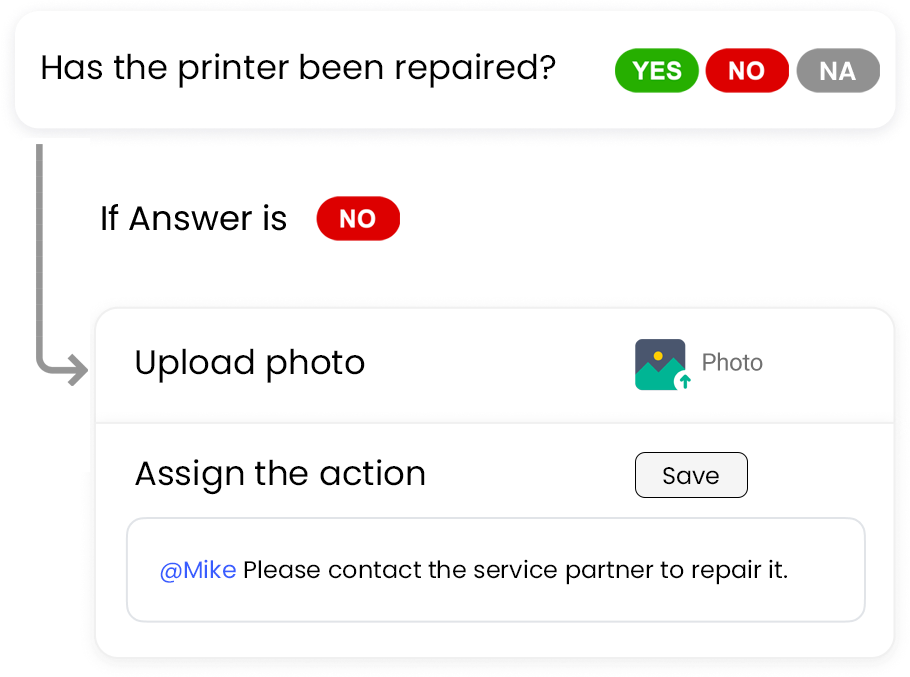
Edit & customize templates as per your needs in simple steps

Pulse allows you to edit the checklists from the library to suit your specific needs. With our smart checklist builder and editor, you can infuse logic in your questions for more clarity and better visibility.

SIGN UP TO EDIT TEMPLATES
Digitize your existing templates in simple steps

Pulse helps you convert your existing inspection templates into digital ones. Simply upload them in PDF, Excel and Word format and leave the rest for our support team. We will get back to you with digital forms.