Spare Parts & Inventory Management Checklist

Automobile Dealership & Workshop Industry

Critical - Labeling & Identification
All parts labeled with part number, description, and vendor code.
Shelves and bins labeled with part category and bin number.
Batch/lot numbers visible on packaging for traceability.
Color-coded labels used to identify new, returned, or defective parts.
Barcode or digital scanning system implemented for inventory tracking.
Receiving & Inspection Process
Incoming parts inspected for quantity, part number, and packaging condition.
Damaged or incorrect parts segregated immediately and marked “HOLD.”
Parts received logged in inward register or DMS system.
All parts received accompanied by vendor invoice and COA (if applicable).
Vendor delivery vehicle inspected for cleanliness and packaging condition.
Return & Warranty Parts
Warranty-returned parts stored separately and tagged with job card number.
Warranty parts dispatch records maintained with pickup receipts.
Rejected or scrapped parts authorized by workshop manager before disposal.
Defective parts stored in secure cage or bin to prevent reuse.
Vendor feedback maintained for warranty claim rejections or delays.
Safety & Housekeeping
No clutter, oil spillage, or packaging waste in parts store.
Material handling equipment (trolleys, forklifts) maintained and available.
Fire extinguishers available and accessible near parts storage.
No smoking or open flames in or near parts store.
Periodic audit conducted for parts store condition and stock control accuracy.
Stock Control - FIFO/FEFO Management
FIFO (First In, First Out) or FEFO (First Expiry, First Out) strictly followed.
Old stock verified and rotated regularly to prevent expiry.
Obsolete or non-moving stock identified and reported to management.
Stock reconciliation conducted monthly between physical and system stock.
System-based inventory updated in real time for all receipts and issues.
Storage Conditions - Mechanical & Electrical Parts
Batteries stored upright and terminals covered with rubber caps.
Rubber and plastic parts stored away from direct sunlight.
Lubricants and fluids stored in closed, leakproof containers.
Paints, chemicals, and adhesives stored separately in ventilated area.
Air filters and cabin filters stored in sealed cartons.
Super Critical - Parts Storage & Handling
Spare parts storage area is clean, dry, and protected from dust and moisture.
Parts are stored on racks and pallets — not directly on the floor.
Segregation maintained between mechanical, electrical, and body parts.
Heavy components (engines, axles) stored in low racks with lifting support.
Sensitive parts (ECUs, sensors, airbag modules) stored in anti-static packaging.
Vendor Management & Compliance
All spare part vendors approved as per OEM/vendor qualification process.
Vendors maintain delivery schedule and quality performance rating.
Purchase orders issued only to authorized and active vendors.
COA or conformity certificates attached for critical parts (engine, brake, safety).
Spare part pricing and discount structure as per OEM policy.

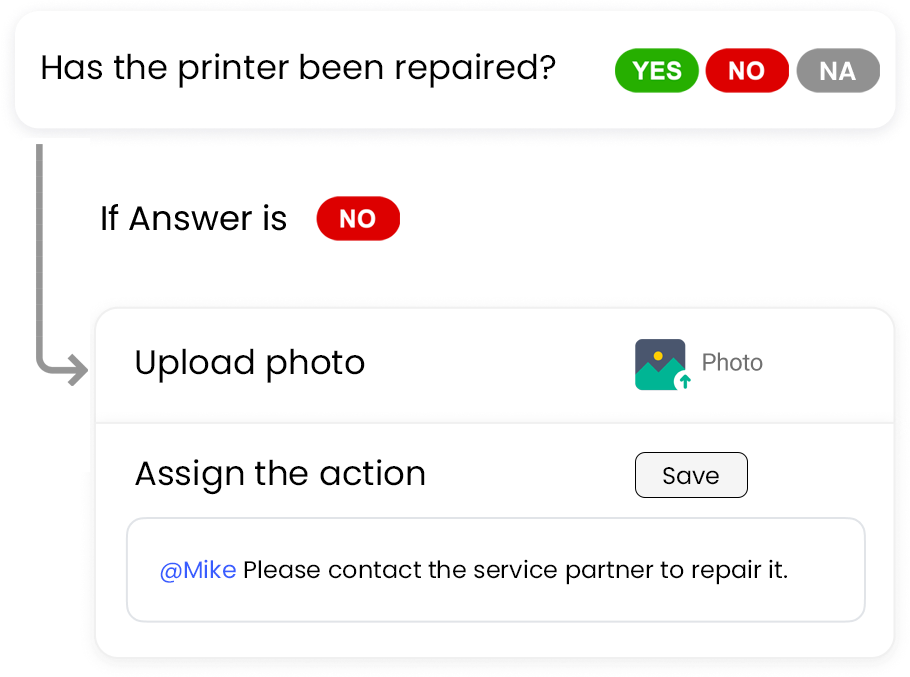
Edit & customize templates as per your needs in simple steps

Pulse allows you to edit the checklists from the library to suit your specific needs. With our smart checklist builder and editor, you can infuse logic in your questions for more clarity and better visibility.

SIGN UP TO EDIT TEMPLATES
Digitize your existing templates in simple steps

Pulse helps you convert your existing inspection templates into digital ones. Simply upload them in PDF, Excel and Word format and leave the rest for our support team. We will get back to you with digital forms.